A sample that was collected by NASA’s Perseverance Mars rover from a dry riverbed in Jezero Crater could preserve evidence of microbial life. Last year, taken from a rock named “Cheyava Falls” the sample called “Sapphire Canyon” contains potential biosignatures.
A potential biosignature, according to NASA, is a substance or structure that might have biological origin, but requires more data or further study before a conclusion can be reached about the absence or presence of life.
NASA’s Administrator, Sean Duffy, states, “The finding was found by Perseverance , it is the closest that NASA has come to discovering life on Mars. The identification of a potential biosignature on the Red Planet (AKA Mars) is a main discovery, and one that will advance our understanding of Mars.”
Perseverance came upon Cheyva Falls during 2024 while exploring the “Bright Angle” formation. The formation is a set of rocky outcrops on the Northern and Southern edges of an ancient river valley, Nertetva Vallis, which is an ancient river valley measuring a quarter mile (400 meters) wide that was carved by water rushing into Jezero Crater long ago.
The rover’s science instruments found that the formation’s sedimentary rocks are composed of clay and silt, which on Earth, are great perseveres of past microbial life. They are also very rich in organic carbon, sulfur, oxidized iron (rust) and phosphorus.
The first to collect data on this rock were Perseverance’s PIXL (Planetary Instrument for X-ray Lithochemistry) and SHERLOC (Scanning Habitable Environments with Raman & Luminescence for Organics & Chemicals) instruments.
When investigating Cheyava Falls, an arrowhead-shaped rock measuring 3.2 feet by 2 feet, they found what looked to be colorful spots. The spots on the rock could have been left behind by microbial life if it had used the raw ingredients, the organic carbon, sulfur, and phosphorus, in the rock as an energy source.
In higher resolution images, the instruments found a pattern of minerals arranged into reaction fronts (which are points of contact where chemical and physical reactions occur) the team had called leopard spots. The spots carried a signature of 2 rich minerals; vivianite (hydrated iron phosphate) and greigite (iron sulfide). Vivianite is often found on Earth in sediments, peat bogs, and around decaying organic matter. Similarly, certain forms of microbial life on Earth can produce greigite.
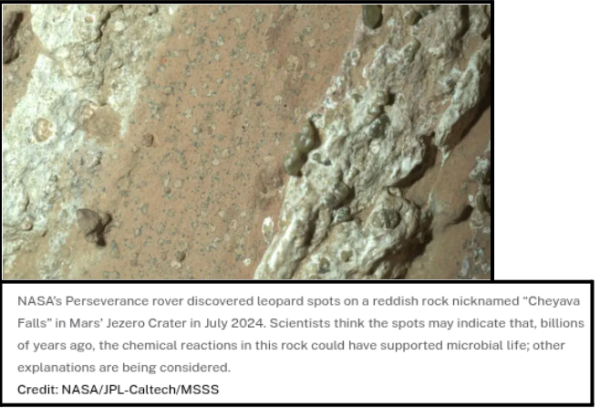
The combination of these minerals, which appear to have formed by electron-transfer reactions between the sediment and organic matter, is a potential fingerprint for microbial life, which would use these reactions to produce energy for growth.
The discovery was surprising because it involves some of the youngest sedimentary rocks the mission has investigated. An earlier hypothesis thought signs of ancient life would be confined to older rock formations. This finding suggests that Mars could have been habitable for a longer period or later in the planet’s history than previously thought, and that older rocks also might hold signs of life that are harder to find.
Are we alone? This potential biosignature can prove that there are other life forms in outer space and eventually, with more advanced technology, we can find them.