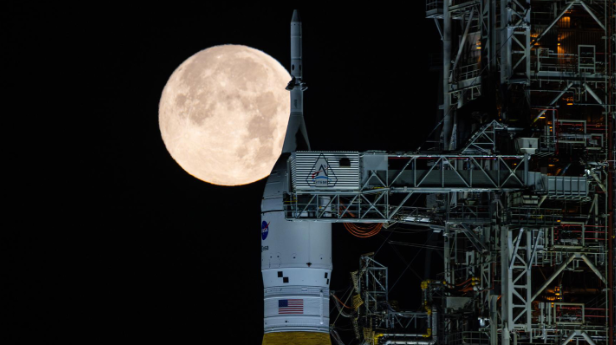
You may have heard about the recent Artemis II mission. It was a historic lunar flyby. It was our first return to the Moon in 50 years. It was also the farthest humans ever traveled. But Artemis II is only the second step in a long and well-thought out plan by NASA to bring humans back to the Moon.
Artemis II took place across a ten-day period – April 1st to April 10th – and it brought 4 elite astronauts around 252,000 miles from Earth. For comparison, our previous record was 248,000 miles. That’s a difference of around 4,000 miles. That’s just about the distance from Long Island to Berlin, Germany. The distance around the Moon (that 250k number) allows you to travel around the Earth 10 times straight.
The crew members are as follows: Reid Wiseman (commander), Victor Glover (pilot), Jeremy Hansen (mission specialist from the Canadian Space Agency), and Christina Koch (mission specialist). Even without the technical accomplishments, this mission is so powerful because it, unlike the Apollo missions, is much more international (Jeremy Hansen is from Canada). Plus, it included the first person of color and the first woman to travel near the Moon.
But let’s talk about the technical achievements. First of all, the launch was picture perfect, taking place on April 1st at 6:35 PM from the Kennedy Space Center in Florida. The spacecraft is called Orion, but the crew nicknamed it Integrity. Afterwards, the crew orbited the Earth a couple of times and tested systems (this is a test mission for future Artemis missions) before performing a critical but successful Translunar Injection (TLI) burn to set them on the course for the Moon and back. This meant no more engines would need to be fired.
Then, on April 6th, they passed that 252,000 mile record, breaking Apollo 13’s and hitting the peak of the mission before looping back around to Earth. On this day, they made many new scientific observations and were able to see parts of the far side of the Moon that have never been seen by human eyes.
Finally, on April 10th, around 8 PM, they splashed down in the middle of the Pacific after a suspenseful travel through the atmosphere, reaching temperatures half as hot as the Sun, protected by a heat shield. A couple hours later, they were back on a boat and off to Houston, where ground control lived.
Now, Artemis III is planned for mid-next year, which will test docking systems with the Orion spacecraft, still manned. And then, Artemis IV will launch, bringing humans back to land on the Moon, with the goal of establishing a kind of colony. And that’s in just two years. Yep, things are speeding up, and fast. So keep an eye out for more space news and information.