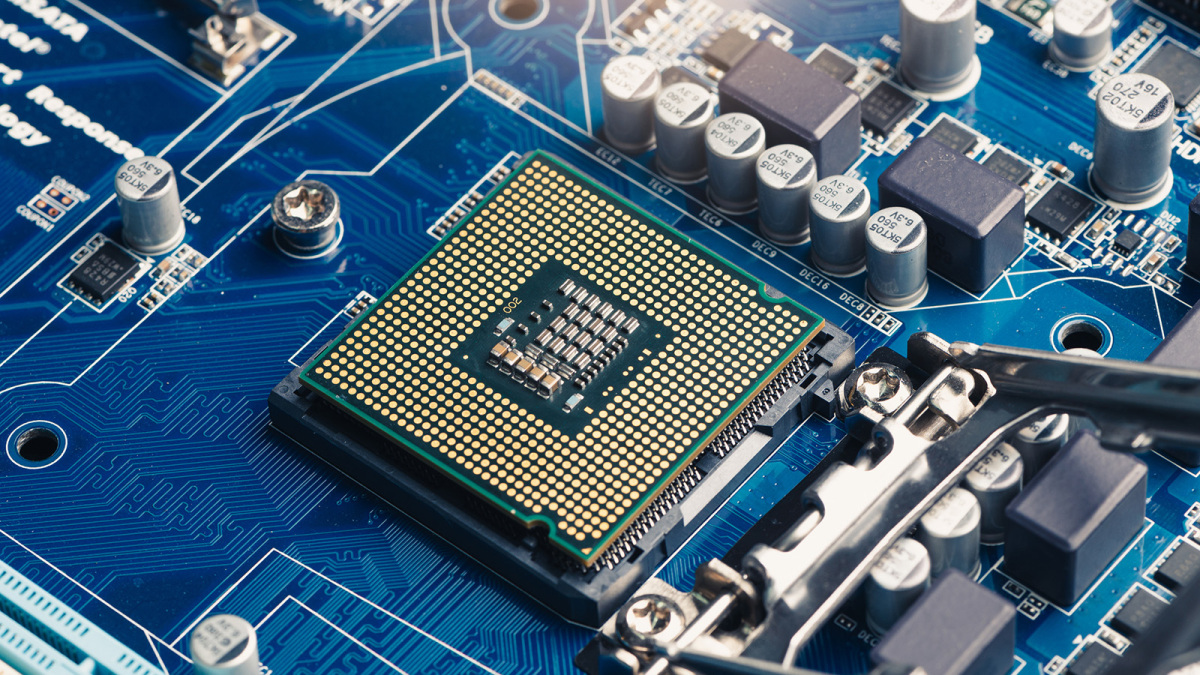
A CPU. You may have heard its nickname – “The Brain Of The Computer.” But what is a CPU? What does it do? Why do computers need it so badly? In this article, we’ll be covering all these bases and explaining how a CPU works in the first place, all the way down to the level of electricity. This article aims to help you understand what makes a CPU do work from the ground up.
Before we even begin talking about the CPU, we need to understand what memory is. In essence, memory is the short-term storage of a computer – you might know it as RAM, or “Random-Access Memory.” This RAM is where programs dump their instructions when they load. These instructions then feed directly into the CPU (which stands for the “Central Processing Unit”).
This data is transported to the CPU, where it first passes through the control unit. In this unit, the memory is decoded using logic gates – which is a whole other topic. After this, the ALU (arithmetic logic unit) actually performs the operations determined by the CU (control unit). Then the results are sent back to the RAM and stored in its memory. Things called registers are utilized to store super short-term memory for the CPU to use.
You might have heard the term “core” when talking in reference to the CPU. A core is just like a mini-CPU, with its own CU, ALU, and registers. Each core has a cache called L1 cache – a cache is a place for short-term memory, kind of like the RAM, but faster, and much closer to the CPU itself. There is L1, L2, and L3 cache – L1 is the fastest and smallest, and is individual to each core, while at the other end, the L3 cache is the slowest but largest, and is shared between cores. L2 is somewhere in the middle and may or may not be shared between cores.
A thread is a series of calculations that is done one after the other. It is the simplest unit of processing a CPU can complete. However, with more than one core, it is possible to run many of these threads simultaneously. Additionally, a futuristic technology called hyper-threading, introduced by Intel, allows for more than one processor inside a core – essentially creating “virtual” cores within each core.
Finally, what is the CPU clock? This clock is a factor in determining how fast a CPU does its operations – it’s the timing mechanic measured in GHz (billions of times a second) which controls and syncs the rate at which the CPU does one step of work per thread.
In summary, the CPU is a complex system that serves as the control center of the computer. It contains multiple units and typically multiple cores/processors, and fetches its data from Random-Access Memory.