October 15 is a day to celebrate White Cane (not stick) Safety Day. President Lyndon B. Johnson signed proclamation 3622 after a joint resolution by Congress urged him to in 1964. They did so because he wanted to raise awareness about the white cane as a symbol of independence and to remind the public of exercising extra courtesy for a person of low vision. The better questions are what is the white cane, how is it used, and what does it achieve for people of low vision?
The white cane is a mobility tool used by people of low vision and people who are blind. It comprises three, sometimes four, sections. The handle, also commonly referred to as the grip, is where the user holds the instrument. There’s a flat part where users are meant to extend their pointer finger; meanwhile, all of the remaining four fingers should wrap around the handle. This movement of the hand provides control, while also allowing the white cane to do its job. Then, the shaft. This part is the longest part of the cane; it’s the middle section that connects the handle to the tip—like how the optic nerve connects your brain to your eyes. And finally,the tip which is arguably the most important section of the white cane. It’s the part that makes direct contact to the ground and the part where users can feel the ground with. It’s what distinguishes concrete from grass, carpeted flooring from marble floor tiles. It’s white, but that’s the highest level of similarity that many will find. There’s the pencil tip, a rolling marshmallow tip, rolling ball tip, hockey stick tip, and so many others! The tip used differ significantly by the preferences of an individual. There are some that are better suited for different types of surfaces, like snow or grass. Then, there’s the cord inside of foldable, or collapsible canes. A white cane that has that feature can typically be folded into sections, which makes the cane smaller after it’s tied by the circular shape of the cord that holds it together.
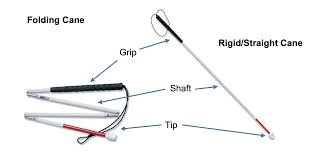
As mentioned before, the white cane is held with the pointer finger extended against the flat part of the grip; meanwhile, all the other four fingers wrap around it. But there’s more to learn about how to use it aside from how to hold it properly, though it’s a step in the right direction. If that’s the hand placement, the arm placement would be to hold it on your dominant arm. While the upper arm remains at your side, your forearm should cross into the midline of your body. The imaginary line dividing the left side of your body from your right side—from the bridge of your nose downwards. Holding the white cane in this manner should form a loose 90° angle, or more accurately an obtuse angle, between your arm and forearm.
This, out of all the steps, may be the most difficult to acclimate yourself with, how to move your wrist when walking. The wrist is meant to move at a gentle, nearly effortless, tilt from the left to right. Not too wide, but not too narrow either. If it’s too wide, it won’t give the cane enough time to move to the other side, and if it’s too narrow, it won’t reach the places it should. Then, when walking, the cane should be on the right side when you move your left leg forward. And when the cane is on the left side, your leg should be taking its next step to the right. It sounds easy in theory, but for some it’s more difficult than read.
Myth: white cane users can’t use stairs. On the contrary, there are methods for both going up and down stairs—both of these are safer when using a railing. Safety first! Alright, alright, to go up stairs, it’s the same way one would walk with it. Except for one minor exception, your arm should be lifted about an inch or three above the ground so the cane is hovering over the steps. Not so much that the cane can’t make contact with the next step, because the cane is meant to be two steps ahead of you. Just keep in mind that you shouldn’t control it too much; the cane should bounce from one step to another as you walk up. This way, you’re two steps behind what’s coming up, and you’ll detect when the last step is. Then, to go down, the cane can touch the ground, but it should still be two steps ahead of you for the same reason.
The white cane is used for a variety of reasons. To feel the ground with the tip, to detect things ahead of you, to pick up when stairs are starting or ending, to provide white cane users a sense of safety that they might have lost with their eyesight. So, next time, you don’t have to grab their cane for them and move it where there’s empty space; the entire reason someone were to use a white cane is to feel what’s ahead. And, if it bumps into something, that’s not a mistake; that’s intentional!However, the white cane can’t detect everything. For example, it can’t warn the user of objects coming above their waist. And sometimes, it could skip over some things. For example; the legs of a table. The cane could very well go under the table, and only when it’s too late will the user realize that!
But educating ourselves shouldn’t be a once-a-year type of deal we practice only when October 15 is near. It’s not like people with a visual disability live like that for one day; they live with it everyday. Being helpful isn’t something we can turn on and off when a national holiday rolls around, it’s something we should make a habit of. And here are some ways to do so…
Be specific with directions and location based instructions –
Surprisingly, not everyone knows where over there or right here is, especially people who can’t see where you’re pointing to. However, nearly everyone can understand what a little to the left or a few inches to the right would be located. It clears up confusion, and has the bonus side effect of someone not wanting to hit you with their cane.
Identify yourself when greeting someone –
“Hey, how have you been?” Could easily be; “Hey, It’s (so and so), how have you been?” People with visual impairments that could be severe enough to prevent them from seeing physical features rely on memorizing someone’s voice instead, and when you might have met that person a month ago… for five minutes in a hectic place…they haven’t memorized your voice. Similar to an animal, smelling new people, that’s what people with vigil impairments do with voices! Plus, it saves an awkward silence from happening as they punter what your name could possibly be.
Verbalize physical queues –
When you look at someone with a visual impairment severe enough to the point where it prevents them from being able to see you’re looking at them…they’re not going to know you are looking at them! So next time, rather than waiting, waiting, waiting, and doing a bit more waiting until you finally look away, try saying “yeah?” Or, “what”, even a hum would be sufficient!
Don’t move their things –
People who are visually impaired often are incredibly organized. Even when it appears messier than a pigsty, they’ll probably know where it is, because they go by their own system. Even their cane, unless they ask you, or are visibly struggling, then you could step in and help out. So next time you think about moving the tooth paste somewhere it typically isn’t, be wary, because they might hide it from you as a form of revenge.
Vocabulary –
You don’t have to get rid of your vocabulary and create a new one from scratch that’s low vision, visually impaired, and blind friendly. You are more than welcome to say “look”, “see”, “watch”, and other words relating to sight.
A kitchen plate can become a clock –
If someone of low vision or someone who is blind is trying to find something on a plate, but all they’re doing is moving their fork around hoping for the best, here’s a tip! After asking if they need help and what they’re looking for, turn the plate into a clock. Imagine the area around the plate is labeled with numbers. Clockwise, 12 up top, three to the right, six at the bottom, and nine on the left. If something is at one that would be in between 12 and three. Ten would be in between nine and 12. And voila! This trick will eventually become easier the more you practice. Just keep in mind that if you’re both not sitting on the same side, but face to face, your six will be there 12 and there three will be your nine!.
Read the menu –
Unexpected plans? New restaurant? The person with a visual disability is finding this all out last second!? If there’s one simple thing you could do to make a situation like that even slightly better…it’s to read the menu. Not all the things, but things you’ve seen them eat, meals you think they might like, something you could try together, the signature dishes, or just ask them what they want and see if it’s on there.
Stay silent before stepping in –
When a person with a visual disability drops something, it practically becomes secondhand nature to listen for it. It becomes a reflex. This is because rather than looking for whatever it is they dropped, it’s more efficient to listen for it to have a sense of direction when they begin to look for it. In immediately asking for help when it falls, they won’t be able to hear it. However, after a minute or so you’re free to ask. Even more so if they ask before you are able to. And if you see them stand up without it, that’s when you really have to step in, because there’s a 90% chance that they already wished whatever they lost a farewell!
Ask them –
If your curiosity is piqued as to what someone with a visual disability can see, because it’s not just black, don’t ask someone else. Ask them. It’s sort of like this; asking a man what a woman feels like on her lady days. Kinda like this; going out of your way to find a secondary source when the primary source is right in front of you. Irritatingly like this; asking someone else in earshot of the person with a visual disability. Go ahead, ask politely with a twinkle of respect and you’ll maybe find out. Just keep in mind that they don’t owe you an explanation, and that’s quite alright.
Devices & technology
iPhones, iPads, laptops, computers, watches, they’re all accessible! As long as there is some sort of magnifier feature, or a screen reader, and the person with a visual disability learns how to use those tools to their advantage, there’s nothing stopping them from being able to doing something anyone else could. There is voiceover for every apple device, along with zoom in features, and jaws for certain desktops, laptops, and tablets. This is why captains are so important for people with visual disabilities, because they rely on the screen readers to read that sort of information. And if you’re comfortable with it, ask a close person to you if they would find it helpful if you were to enable these features on your own device. Because more often than not, when you show them something they’re just telling you what they think you would like to hear. When in reality, they might have less than a clue on what you were showing them. And if you’re up to it, ask for them to teach you how to use them as well!
Not all jokes about a disability are funny, some don’t even hold a speck of humor in them, especially if they’re relating to a disability and the person with said disability is excluded from the “joke” that pokes fun at them. However, these are a handful of silly, little, puns that appeal to both cited and people with a visual disability while still being respectful, because that was a ton of info:
- “I don’t like blind jokes. I just can’t see the point.“
- Why did the blind man fall down the well? He couldn’t see that well.
- I’m reading a horror story in Braille. Something bad is about to happen… I can feel it.”
- A sighted person bumps into a blind man. The sighted person quickly says, “Oh, I’m so sorry, I didn’t see you there!” The blind man replies, “I didn’t see you either.”
- An out-of-towner drove his car into a ditch in a desolated area. Luckily, a local farmer came to help with his big strong horse named Buddy. He hitched Buddy up to the car and yelled, “Pull, Nellie, pull!” Buddy didn’t move. Then the farmer hollered, “Pull, Buster, pull!” Buddy didn’t respond. Once more the farmer commanded, “Pull, Coco, pull!” Nothing. Then the farmer nonchalantly said, “Pull, Buddy, pull!” And the horse easily dragged the car out of the ditch. The motorist was most appreciative and very curious. He asked the farmer why he called his horse by the wrong name three times. “Well… Buddy is blind and if he thought he was the only one pulling, he wouldn’t even try!” —
- There once was a blind man who decided to visit Texas. When he arrived on the plane, he felt the seats and said, “Wow, these seats are big!” The person next to him answered, “Everything is big in Texas.” When he finally arrived in Texas, he decided to visit a bar. Upon arriving in the bar, he ordered a beer and got a mug placed between his hands. He exclaimed, “Wow these mugs are big!” The bartender replied, “Everything is big in Texas.” After a couple of beers, the blind man asked the bartender where the bathroom was located. The bartender replied, “Second door to the right.” The blind man headed for the bathroom, but accidentally tripped over and skipped the second door. Instead, he entered the third door, which leads to the swimming pool and fell into the pool by accident. Scared to death, the blind man started shouting, “Don’t flush, don’t flush!”
- A teacher at a school for blind kids is taking his school’s soccer team to an “away game”. They stop for a rest break, and to let the kids work off some energy with a little impromptu practice in a nearby pasture. The teacher is sitting in a nearby diner, explaining to another patron how it is that blind kids can play soccer. “We made a special ball, with a bell in it, so the kids can keep track of where the ball is and what it’s doing by listening for it. They’re pretty good at it too.” “Very clever!” remarks the other patron. Just then they are interrupted as another patron, who is looking out the window, says, “Hey! Are you the guy with those damn blind kids from the bus?” “Yes,” says the teacher, stung by the way “his” kids are being referred to, “what about it? You got something against blind kids?” “Nothing, ordinarily,” says the guy, still scowling out the window, but you better get them rounded up quickly! They’re kicking the hell out of my best milk cow!”