After Thanksgiving passed, it’s finally time for Christmas with the stockings, the lights, the trees, and hot cocoa, but what happened in history this week?
On December 1st, 1959, the Antarctic Treaty was signed by twelve nations including the United States and Soviet Union and forbids any military activity and weapon testing on Antarctica, allowing the continent to be shared among nations in use of science and research. Since the 1800s, nations have sent explorers to the continent to stake their claims that the continent belongs to them, creating tensions between these nations and caused armed clashes between nations. In 1948, Argentine military forces fired on British troops in an area claimed by both nations. Incidents of armed conflicts, and the Soviet Union having an interest in the continent, spurred the United States so much that they wanted a treaty to be made for the continent under an international organization. This idea didn’t sit well with other nations due to their territories on the continent, but by the 1950s, American diplomats were making treaties with their USSR counterparts to make a peace treaty over the continent. The treaty didn’t tamper with issues of territorial sovereignty in Antarctica. The treaty marked the first step towards a U.S.- Soviet arms control and political cooperation. The treaty took effect in June 1961, and set the standards for the basic policies that continue to govern Antarctica.
On December 2nd, 1942, Italian physicist Enrico Fermi produced the first nuclear chain reaction, ushering the nuclear age. Enrico Fermi fled Italy due to the radical beliefs in the government against Jewish people, and his wife, who was Jewish, used an opportunity to travel to Stockholm, and emigrated to the United States. He was originally on the hunt for element 93, which is Neptunium (Np), while launching neutrons at Uranium 92 while under bombardment, thus increasing the weight of its atomic weight, but he didn’t discover a new element. In 1939, he and other fellow scientists saw the potential for the atomic power to be used in military weapons like bombs, so they quickly wrote a letter to President Roosevelt to warn him of the perils of a German atomic bomb. The letter was signed and delivered to the president by Albert Einstein on October 11th, 1939. This led to the creation of the Manhattan Project and the need to make an atomic bomb before Germany does. While under the stands of the University of Chicago Stagg Field, they have discovered the nuclear chain reaction. Upon the success of the reaction, a coded message was transmitted to President Roosevelt: “The Italian navigator has landed in the new world.”
On December 3rd, 1967, the first human heart transplant was performed in Cape Town, South Africa. The surgery took from 5 to 6 hours to complete and was performed by Dr. Christiaan Barnard, who led the team of other doctors. The patient was Louis Washkansky, a 53-year-old man with severe heart failure. The donor was Denise Darvall, a 25-year-old man who was considered brain dead after a car crash. Washkansky would survive after the surgery for 18 days (2 weeks and 4 days), but he ultimately died from pneumonia. This proved that it was possible that a human heart could be transplanted.
On December 4th, 1783, George Washington rallied up his military officers to Fraunces Tavern in New York City, and informed them that he will be resigning his commission and return to civilian life. Following the surrender at Yorktown by General Cornwallis, the peace treaty had not concluded yet for two years with all British troops to leave New York. Colonel Benjamin Tallmadge wrote about his account of the farewell, describing Washington as “suffused in tears,” embracing his officers one by one after issuing his farewell. Washington would head to Annapolis, Maryland, where he would officially resign from his commission on December 23rd. He would live on his beloved estate of Mount Vernon, Virginia until 1789, where he was elected the first president of the United States, a position he held until 1797.
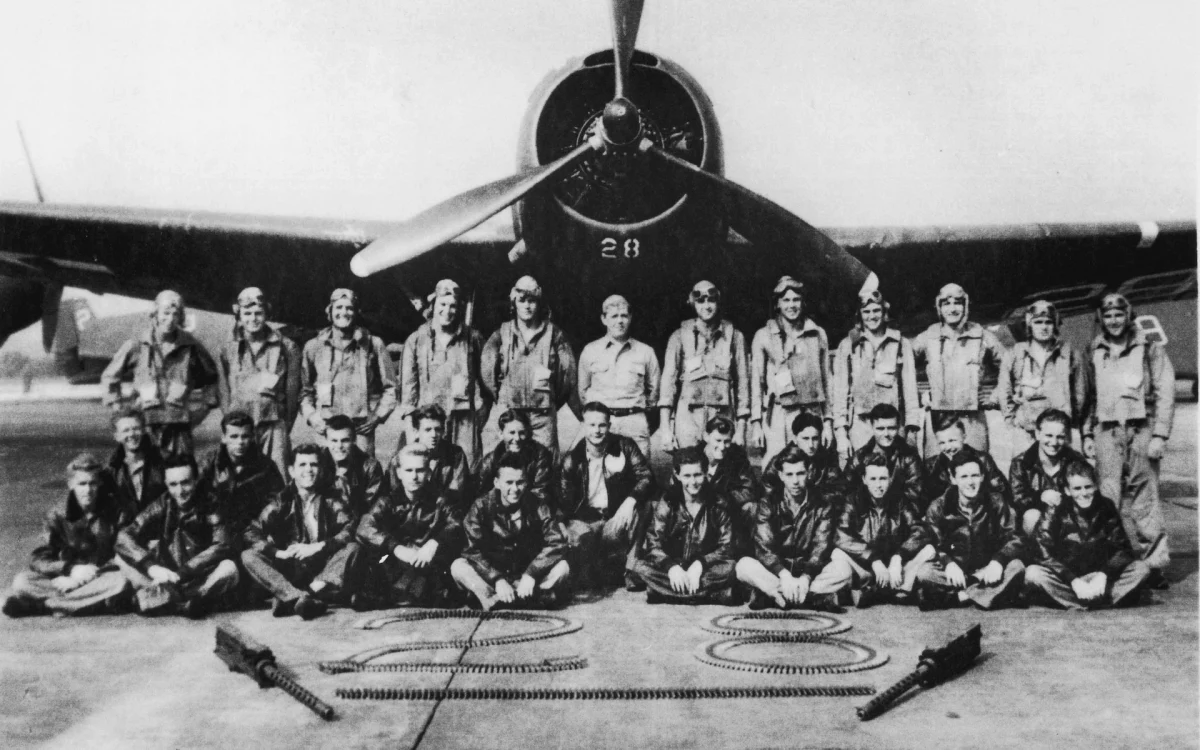
On December 5th, 1945, a squadron of 5 U.S. Navy Avenger torpedo bombers, known as Flight 19, disappeared over the Bermuda Triangle during a training mission. They took off from Fort Lauderdale, Florida, for a routine 3 hour training mission, but there was a problem. The problem was reported by Lt. Charles C. Taylor, the squadron leader, and that his compasses and other instruments had failed. He became disoriented, believing they were over the Florida Keys when they were likely in the Bahamas. All 14 crew members of Flight 19 were lost, so a PBM Mariner flying boat with 13 crew members was sent to find the lost fleet, but it also disappeared. Many theories that came from this disappearance include navigational error or bad weather, but the cause is still unknown. This is one of the most famous incidents of the Bermuda Triangle and fueled the mysteries behind it.