If you’ve been keeping up with the space news, you’ve probably heard of the interstellar comet 3I/ATLAS. You may get to get a glimpse of it soon, as it’s going to be at its closest point to Earth this month. Here’s everything we know so far about the comet.
The ATLAS ( Asteroid Terrestrial-impact Last Alert System ) telescope first reported their observations of the comet on July 1, 2025 in Rio Hurtado, Chile. By observing its speed and trajectory, astronomers confirmed that it had come from another solar system. They also learned that it’s most likely billions of years old. It was officially named 3I/ATLAS ( “I” is for “Interstellar”, “3” is because it’s the third known object coming from outside our solar system, and “ATLAS” named after where it was discovered ) and its diameter was estimated to be between 3.5 miles to 1,000 feet. It has a hyperbolic orbit, meaning its velocity is high enough to avoid the gravitational pull of other central bodies and it’s a one way trip past our solar system.
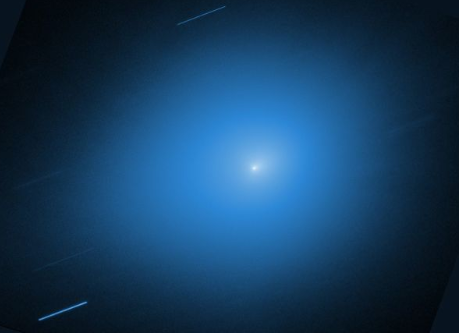
Why has it been getting so much attention? There has been a popular conspiracy theory that the comet is actually an alien spaceship. NASA and the European Space Agency ( ESA ) have denied these claims, both saying it’s a naturally made comet, but the fact that 3I/ATLAS has a “heartbeat” is also adding to the suspicion of aliens. Every 16.16 hours, 3I/ATLAS periodically dims and brightens like it has a pulse. Avi Loeb, the Harvard scientist that proposed the idea of aliens, says that it could be an internal cycle from the spaceship/comet. However, researches say the natural cause for this is that as the comet rotates, the Sun turns the icy spots on the outside of the comet into gas, creating jets of gas and dust that brighten. NASA continues to send pictures of 3I/ATLAS with its coma and tail throughout this debate.
If you want to see the comet yourself, it’ll be closest to Earth on December 19. It’ll be 170 million miles from Earth, about twice the distance of the Sun and Earth. You won’t be able to see it with your naked eye so grab a good pair of binoculars or a small telescope ( NASA recommends one with an aperture of at least 12 inches ). Before dawn, look east to northeast in the constellation Leo, around the star Regulus for a faint patch of light. Use a tracker like TheSkyLive or NASA’s Eyes On The Solar System for coordinates in real-time.