For the past 3 months I’ve been learning how to fence on the school’s fencing team. This is what I learned about fencing as a complete novice.
To start, there’s three different weapons in fencing:
The saber, which is the weapon with the fastest pacing and the shortest blade. In order to score a point in competition the normal way, the fencer must either slash or thrust into the opponents electric gear whilst abiding to the right of way. The first to initiate the attack or riposte will score the “touch” if they make contact with their blade. A riposte is an attack made subsequent to a parry (the deflection of the opponent’s blade).
Commonly said to be second to the saber in pacing is the foil. The foil was originally made to be used as a stylish dueling sword that was easy to carry around. The foil is allowed to be slightly longer than the saber in competition but to score a touch they must make contact with the button at the end of the blade and can’t score touches on the arms and must reach the torso to get points. Foil fencers must also abide to the right of way.
The final and slowest of the three weapons is the épée. It is the longest and most heavy of all the weapons. This isn’t just because of the length but also that it has a cup shaped guard that can entirely conceal the hand and a wider blade near the guard primarily used to gain greater control of the opponent’s blade during parries.
In épée it’s considerably more simple to score touches as there is no right of way, the entire body is a target, and both fencers are able to score a touch if they both land their attacks within 50 milliseconds (a twentieth of a second) of each other. To score a touch the fencer must press the button on the tip of the épée with a minimum of 750 grams of force upon their opponent so it is electrically registered through the weapon.
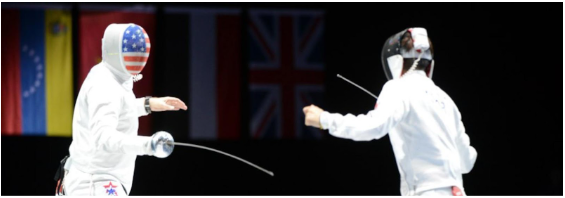
Before a match begins or after a point or fault is made both fencers must go into the en garde position.
The standard en garde is one where the dominant arm is held forward, elbow bent to allow a little under 2 fists of distance from the torso. The less dominant arm is held back with the arm up but may be let to rest. Crouching a bit with the dominant leg perpendicular to the lesser.
From that point onwards the fencers will try to score points before their opponent with a variety of honed techniques.
In summation fencing is an intricate sport with many classes, techniques, and scenarios. Where both the prowess of mind and body unite to decide the victor.